Handshape
Handshape refers to the configuration of the hands and is likely a distinctive parameter in all sign languages.
100% of documentation on 87 sign languages in the Sign Language Analyses (SLAY) database identify handshape as a distinctive parameter. (Tatman 2015)
Selected fingers
The selected fingers of a handshape are considered the active fingers of the hand that:
- Can assume a specific configuration (e.g. extended, bent, hooked)
- Can have internal movement (e.g. wiggling)
- Are the fingers that contact other locations or hands
Marked and unmarked handshapes
Marked handshapes are handshapes that tend to have certain phonotactic constraints:
- Marked handshapes usually do not undergo internal movement
- Marked handshapes usually do not appear in classifiers
- Marked handshapes are more restricted in how they contact a location
- In Type 3 signs, marked handshapes are usually disallowed in the nondominant hand
What handshapes are considered marked in a language differs depending on the language. However, linguists do not agree on a single set of criteria for what should be considered a marked or unmarked handshape.
Handshape inventories and distribution (Rozelle 2003)
Sign languages each have different handshape inventories, though even unrelated languages may share many handshapes in common. Languages with larger handshape inventories have larger location inventories as well.
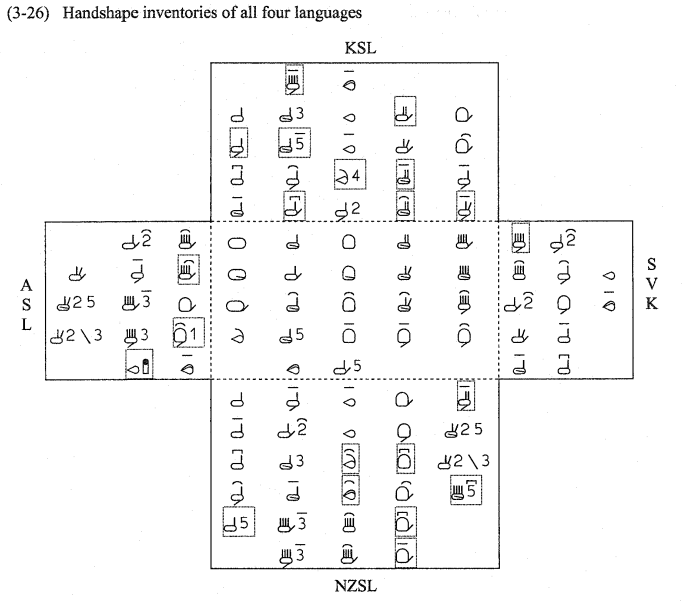
In a comparison between the four unrelated sign languages ASL, KSL, NZSL, and SVK, the handshape inventory sizes ranged from 34 to 49, with an average of 40 and a standard deviation of 7. Among these four languages, 22 handshapes were used in common.
| ASL | KSL | NZSL | SVK | VSVK | LIS | |
|---|---|---|---|---|---|---|
| Inventory size | 35 | 44 | 49 | 34 | 28 | 41 |
Handshapes used only in certain signs
Some handshapes that are present in a language's inventory are only used in signs with a handshape change or in signs with borrowings from another language. Different sign languages have different sets of such handshapes.
For example, in KSL, the handshapes used only in handshape changing signs are
Languages like ASL and NZSL have handshapes that appear only in their associated fingerspelled alphabet and signs that borrow from it, such as the NZSL fingerspelled letter S
KSL also has handshapes that occur only in borrowings, including those that borrow from the shape of the corresponding Chinese character. For example, SAN mountain has a handshape