Location
Location refers to the part of the body where a sign is articulated.
94.25% of documentation on 87 sign languages in the Sign Language Analyses (SLAY) database identify location as a distinctive parameter. (Tatman 2015)
Neutral space
The most common location for signs is neutral space, the area in front of the signer's torso.
Neutral space is a rather large region, but the precise zone within neutral space that a sign is produced in does not change its meaning. Different parts of neutral space may however be used to index referents, similar to pronouns.
Nondominant hand
The nondominant hand is considered a location, and in some research, the different handshapes the nondominant hand can take are each considered their own location.
For example, Rozelle 2003 distinguishes between the "default" hand configuration, where the nondominant hand's shape is the same as the dominant hand's shape, and the various handshapes the nondominant hand were observed to take (such as
Location inventories and distribution (Rozelle 2003)
Sign languages each have different location inventories, though even unrelated languages may share many locations in common. Languages with larger location inventories have larger handshape inventories as well.
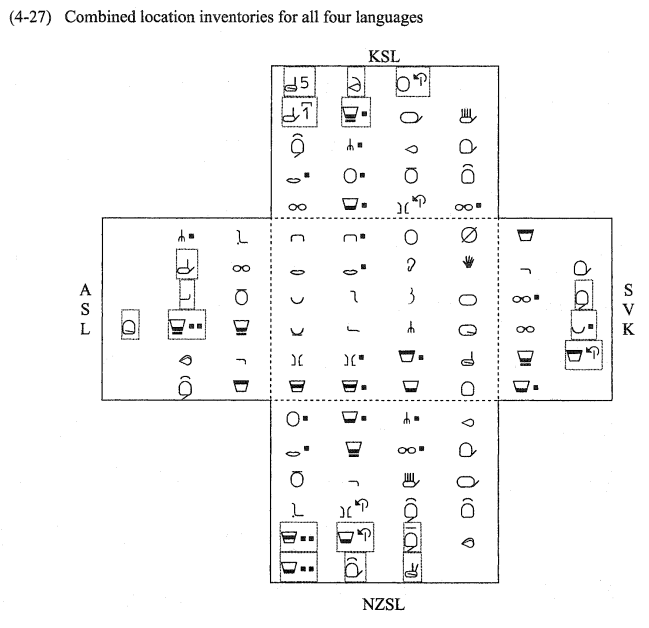
In a comparison between the four unrelated sign languages ASL, KSL, NZSL, and SVK, when different nondominant hand shapes and neutral space are included, the location inventory sizes ranged from 34 to 47, with an average of 40 and a standard deviation of 6. Among these four languages, 24 locations were used in common.
When neutral space and hand locations are not considered, the four languages' inventory sizes ranged from 26 to 31, with an average of 28 and a standard deviation of 2.
| ASL | KSL | NZSL | SVK | VSVK | |
|---|---|---|---|---|---|
| Body locations | 27 | 27 | 31 | 26 | 17 |
| Hand locations | 11 | 15 | 16 | 8 | 10 |
| Total locations | 38 | 42 | 47 | 34 | 27 |